
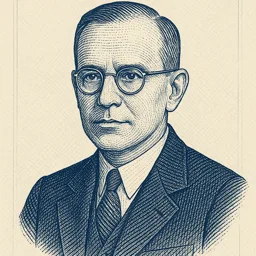
Harry Nyquist
1889 – 1976
Sampling and thermal-noise theory from Bell Labs.
A Swedish-American engineer at Bell Labs, Nyquist established the sampling theorem (how fast you must sample a signal) and, with Johnson, explained thermal noise — two results at the foundation of all digital and RF measurement.
The ADC-resolution and thermal-noise tools here rest on Nyquist's work. His name is on the rate every data-acquisition system is designed around.
Portrait: a stylized blueprint-line rendering, not a photograph.
Contributions in the toolbox
- 1924
Relates signaling rate to bandwidth, seeding the capacity idea.
→ Shannon-Hartley Channel Capacity - 1928
Sampling rate theorem groundwork.
→ ADC Resolution - 1928
Derives kTB from thermodynamics.
→ Thermal Noise Floor - 1928
Relates signaling rate to bandwidth in telegraph transmission.
→ Nyquist Rate & Aliasing - 1928
Fixes the sampling limit at half the sample rate — the top bin of any FFT.
→ FFT Bin Width & Resolution - 1928
Shows telegraph channels need ≥2 samples per cycle of the highest frequency — the Nyquist rate.
→ Anti-Alias Filter Attenuation - 1932
Publishes the encirclement stability criterion around the −1 point.
→ Phase & Gain Margin - 1932
Stability criterion that made frequency-domain loop shaping possible.
→ Lead / Lag Compensator Design