
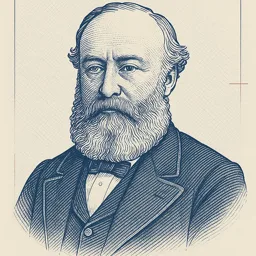
James Prescott Joule
1818 – 1889
Brewer's son who proved heat is a form of energy; the joule is his.
A Manchester brewer's son and largely self-funded, Joule proved through meticulous experiments in the 1840s that heat and mechanical work are the same currency — the mechanical equivalent of heat. The unit of energy carries his name.
His paddle-wheel apparatus measured temperature rises so small that peers doubted him; the result founded the conservation of energy. Every energy-conversion and heating calculation here is denominated in Joule's insight.
Portrait: a stylized blueprint-line rendering, not a photograph.
Contributions in the toolbox
- 1841
Quantifies electrical heating — the P = VI power relation.
→ Ohm's Law - 1841
I²R heating — the physical meaning of RMS.
→ RMS ⇄ Peak ⇄ Peak-to-Peak - 1843
Falling-weight experiments price mechanical energy in heat.
→ Gravitational Potential Energy - 1843
Paddle-wheel experiments price heat in work, refined through 1850.
→ Energy Converter - 1843
Mechanical equivalent of heat — energy accounting unified.
→ Heat Exchanger Duty