
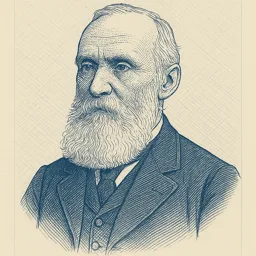
William Thomson (Lord Kelvin)
1824 – 1907
Laid the transatlantic cable's math and an absolute temperature scale carries his name.
Thomson was the Victorian era's model of the scientist-engineer: professor at Glasgow at 22, architect of the first successful transatlantic telegraph cable, and namesake of the absolute temperature scale. His cable analysis produced the RC time-constant law that still sets settling times in the calculators here.
Knighted for the cable and later made Baron Kelvin, he held over 70 patents and helped found modern thermodynamics alongside Rankine and Joule. When a tool references absolute temperature or a telegraph-era transient, that is Kelvin.
Portrait: a stylized blueprint-line rendering, not a photograph.
Contributions in the toolbox
- 1848
Absolute thermodynamic temperature scale.
→ Temperature Converter - 1850
The term 'kinetic energy' coined.
→ Kinetic Energy - 1851
Defines the absolute temperature scale that puts T in the efficiency ratio.
→ Carnot Efficiency Limit - 1852
Describes running a heat engine in reverse to heat buildings — the heat pump concept.
→ Heat-Pump COP + Reversible Limit - 1853
Predicts LC oscillation mathematically.
→ LC Resonant Frequency - 1853
LC oscillation predicted — the reactive tug-of-war.
→ Series RLC Impedance - 1855
RC law of the telegraph cable — the time constant's debut.
→ RC Low-Pass Filter - 1855
RC transient law from telegraph cable theory.
→ RC Charge Time - 1856
Discovers resistance changes with strain.
→ Strain Gauge Output - 1861
Double bridge extends null measurement to milliohms.
→ Wheatstone Bridge - 1861
Four-terminal (Kelvin) sensing removes lead error.
→ Shunt Resistor - 1887
AC resistance of practical conductors quantified.
→ Skin Depth