
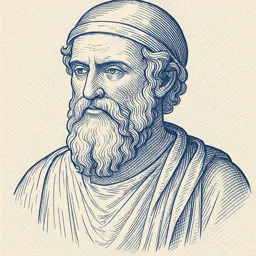
Archimedes
287 BCE – 212 BCE
Buoyancy, levers, and the mechanics the ancient world never surpassed.
The greatest engineer-mathematician of antiquity, Archimedes of Syracuse gave us the principle of buoyancy, the mechanics of levers and pulleys, and methods of calculating areas and volumes that anticipated calculus by nearly two millennia.
Killed by a Roman soldier during the siege of Syracuse, reportedly mid-proof, he left a body of mechanics the world did not surpass for centuries. The buoyancy and lever tools here begin with him.
Portrait: a stylized blueprint-line rendering, not a photograph.
Contributions in the toolbox
- 250 BCE
Law of the lever proven from first principles.
→ Lever Mechanical Advantage - 250 BCE
Law of the lever — moment as force times arm.
→ Torque Converter - 250 BCE
Areas and volumes of curved figures — the segment's ancestry (circa).
→ Horizontal Tank Volume - 250 BCE
Volume of the cylinder — the formula, permanently (circa).
→ Vertical Tank Volume