
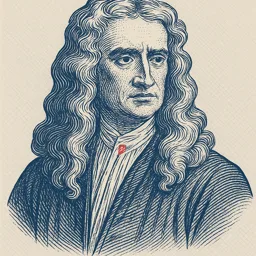
Isaac Newton
1643 – 1727
Motion, gravitation, and the calculus — the foundation the rest build on.
Newton's 1687 Principia set out the laws of motion and universal gravitation and, with them, the mathematical physics every later engineer inherited. Drag, projectile motion with resistance, the speed of sound, and orbital and escape velocity all trace to that single book.
Reclusive, combative, and endlessly curious — he spent as much effort on alchemy and theology as on physics — Newton nonetheless gave engineering its foundation. Several calculators here compute quantities he was the first to frame.
Portrait: a stylized blueprint-line rendering, not a photograph.
Contributions in the toolbox
- 1687
Principia adds drag — and takes the parabola away.
→ Projectile Range (No Drag) - 1687
First theoretical sound speed (air) in the Principia.
→ Speed of Sound in Materials - 1687
Principia — resistance proportional to V².
→ Drag Force - 1687
V² drag regime quantified.
→ Terminal Velocity - 1687
Orbits derived from gravitation; the cannonball argument.
→ Circular Orbit Velocity & Period - 1687
The cannonball argument defines escape.
→ Escape Velocity - 1687
Principia embeds moments in the laws of motion.
→ Torque Converter