
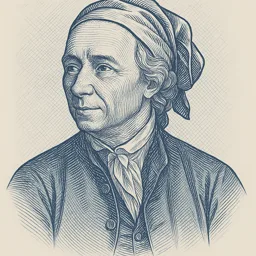
Leonhard Euler
1707 – 1783
The most prolific mathematician in history; his notation underlies most of engineering.
Born in Basel in 1707, Euler trained under Johann Bernoulli and became the defining mathematician of the 18th century — so prolific that the St. Petersburg Academy was still publishing his backlog decades after his death. He gave us the notation engineers use without thinking: f(x), e, i, Σ, and the trigonometric conventions on every calculator here.
He went blind in his later years and kept working, dictating papers from memory and mental calculation. His formulas underlie beam theory, fluid dynamics, and control — when a tool on this site invokes e or a sine, it is speaking Euler's language.
Portrait: a stylized blueprint-line rendering, not a photograph.
Contributions in the toolbox
- 1744
Critical buckling load derived via calculus of variations.
→ Euler Column Buckling - 1744
Publishes the elastica — the beam curvature theory under every deflection formula here.
→ Flitch Beam Composite Deflection - 1748
Circular-function machinery — ω = 2πf.
→ Frequency ⇄ Period - 1748
e and the exponential function formalized.
→ RC Charge Time - 1748
Formalizes compound-interest and annuity series in Introductio in analysin infinitorum.
→ Loan Amortization Payment - 1750
The Euler–Bernoulli beam equation — the math under this card.
→ Beam Deflection - 1754
Involute tooth profile analyzed — the modern gear tooth.
→ Gear Ratio - 1754
Euler's turbomachine equation.
→ Pump Hydraulic & Shaft Power - 1754
Turbomachine equation — pumps deliver head, not pressure (circa).
→ Pump Head ⇄ Pressure - 1757
Equations of compressible fluid motion.
→ Isentropic Flow Ratios - 1757
Continuity embedded in the general flow equations.
→ Pipe Flow Velocity - 1757
The equation in its modern form.
→ Bernoulli Pressure Change - 1765
'Moment of inertia' defined; rigid-body dynamics founded.
→ Mass Moment of Inertia (Shapes)